Thursday, September 28, 2006

Aoe 2 No Cd Multiplayer

StrongTalk - VM is also now open source!


few days ago, Sun released the VM StrongTalk .

For those who do not know which is StrongTalk, I tell StrongTalk is the proof that (actually the second test, the first is the virtual machine Self ) that dynamic languages \u200b\u200bare not necessarily slow.

For the nostalgic: Read the rough (because of Java) StrongTalk history .

It is time we stop talking about whether a language is quick or not because you have (or not) a compiler to machine code or if it runs on a virtual machine. Things are a little more complicated and the simple fact of having or not a compiler to machine code is only part of the story.

If you believe that what I say is true, take a little time to read the papers which are available at:

http://research.sun.com/self/compiler.html

http://www.strongtalk.org/documents.html


Of course this is good news not only for Smalltalkers, but the Ruby and Python communities can also benefit much if implemented in their respective virtual machines, technologies that have StrongTalk VM. Look at the reactions produced by this news, in communities Ruby and Python:

http://www.google.com/search?q=strongtalk+ruby

http://www.google.com/search?q=strongtalk+python


UPDATE: Coverage Slashdot.

Wednesday, September 27, 2006

Baby Shampoo Ingredients

Web 2.0 - A new medium: LiveWiki (Better Wiki)


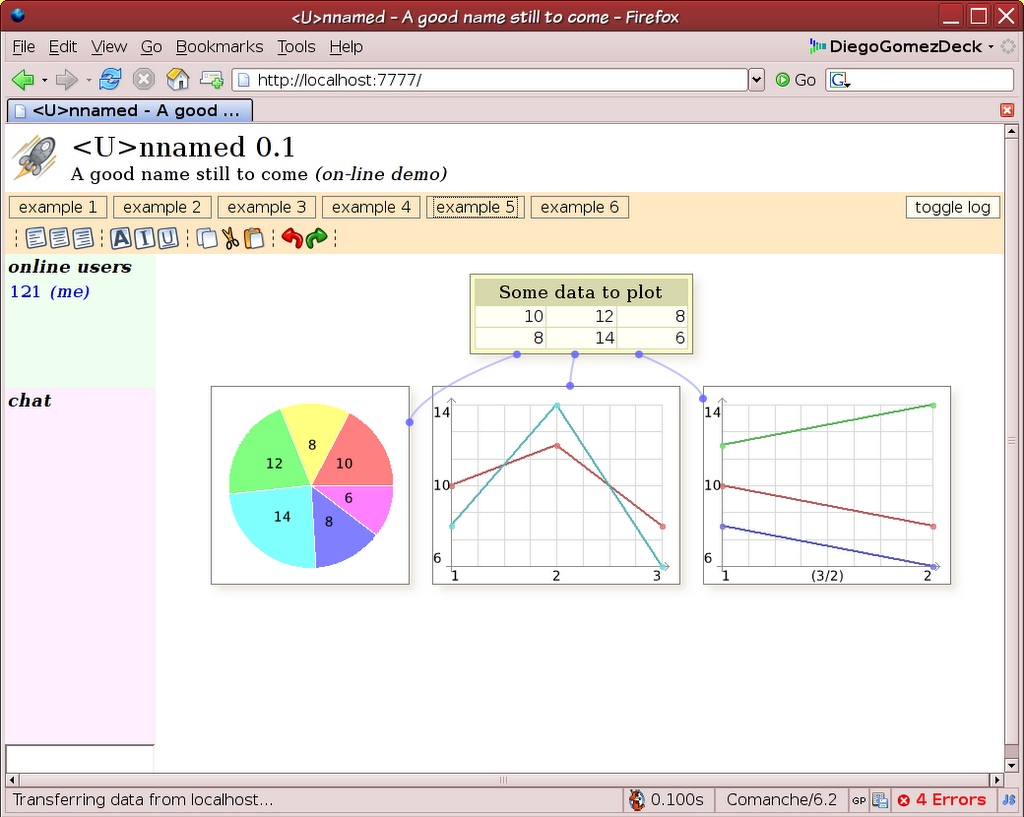
Following the examples of possible new uses of Web 2.0, now let's try to imagine how they could improve the current wikis, collaboration using Web 2.0 allows us .

I present the first version of LiveWiki . LiveWiki Wiki is a living (hence the name;)). Wiki in the sense of being a site editable by many people ( http://es.wikipedia.org/wiki/Wiki ), and live in the sense that we have been giving the word in the notes.

To put it another way: We forget having to "refresh" , "recharge" , "reload" or "refresh" of the page to see if it changed. When the page changes, all the people viewing that page will see the change at the very moment it happens. Likewise, all connected users can change the content. And, as in the examples above, the chat between users connected serves to coordinate the work.

This version is still very simple ... but it has been clear improvements wikis may suffer if we get these technologies adoption increases.

This is a list of things NOT LiveWiki makes this version, but I intend to include in future versions:
  • pessimistic lock timeout for editing. To edit a page (or part thereof), first obtain a lock. When someone has a lock on the one hand, no except you can change, and nobody can get a lock until the button is released. Feedback
  • visual
  • block: Users who do NOT have locked the page (or part thereof) will see that someone has it locked with a background color change. They could even see who has blocked and harassed by the chat to let go. ;-)
  • visual edition of the content. This version uses one of the wiki syntax (specifically using the syntax of the Swiki). The idea is to make a visual editor (or adapt one already made, like the TinyMCE http://tinymce.moxiecode.com/ ). Reorganization
  • visual content. Something in the way of http://tool-man.org/examples/edit-in-place.html . We must think like finish combine that with the locks.
  • Editing of the content. In order to reduce the update conflicts, you can modify only a portion of the page while other users may be, at once, altering other parts. Etc.

And these are some of the features which are included in this release:
  • Live Update of pages when a page link referenced in a change of name.
  • Live Update of pages that have links to pages that still are not created, when they are created (the link to an uncreated page is different, visually, a link to a page that already exists). Links
  • type "Embedded." When we link this way * [One Page] * content on the page named "A Page" be embedded in the containing page. The same for a link of type * {A} * page, but then embeds the page title (instead of content).
  • There are pages and pages modifiable non-modified (as the Pages page, which displays a list of all pages created in the wiki).

And to continue with self-imposed tradition, I leave a screencast that shows some of the features of LiveWiki.

http://www.consultar.com/trastero/LiveWiki1.htm

As always, all available sources SqueakSource .

Tuesday, September 19, 2006

Gul Indian Actress Boobs

Squeak eToys Available for computer

Yoshiki announced Squeak list availability Squeak image to be used in laptops 100USD.

Calls
comments, suggestions, bug reports, etc.

Tuesday, September 12, 2006

Pattern For Dog Draught Excluder

100USD Web 2.0 - A new medium: A better spreadsheet Squeak Pictures

To be honest, years ago I stopped paying attention to the long list of names and acronyms generated by the fashion industry. However, with the intention that people will find these notes in google, a number of posts that I am using the terms "modern" as Web 2.0, Ajax and stuff.

I want to keep showing them examples of course is my opinion (and to dump my opinion is that I started a blog), possible good uses of interactivity that allows the Comet (oops, another word fashion).

This example also seeks show otherwise: ugly and bad What are the applications that are used (or force us) to use!

Let's talk about the spreadsheets. Spreadsheets have for years without evolving. I do not mean small changes that vendors make to sell the versionActual +1, but I mean evolution (thus, large print).

few months ago I met Spreadsheet 2000. I explained that I am not Apple user and I never saw this product on foot. I learned of its existence in an e-mail list Squeak.
Googling I found also this page that tells a little more:

http://www.mactech.com/articles/mactech/Vol.13/13.04 / Spreadsheet2000/index.html


Spreadsheet When I heard 2000, I could not help feeling that nostalgia for a stranger who was not present. The truth that we really, really bad computers and we (the developers) bear substantial responsibility for this situation. Most of the time condemning the experiences users rigid and, above all, boring.

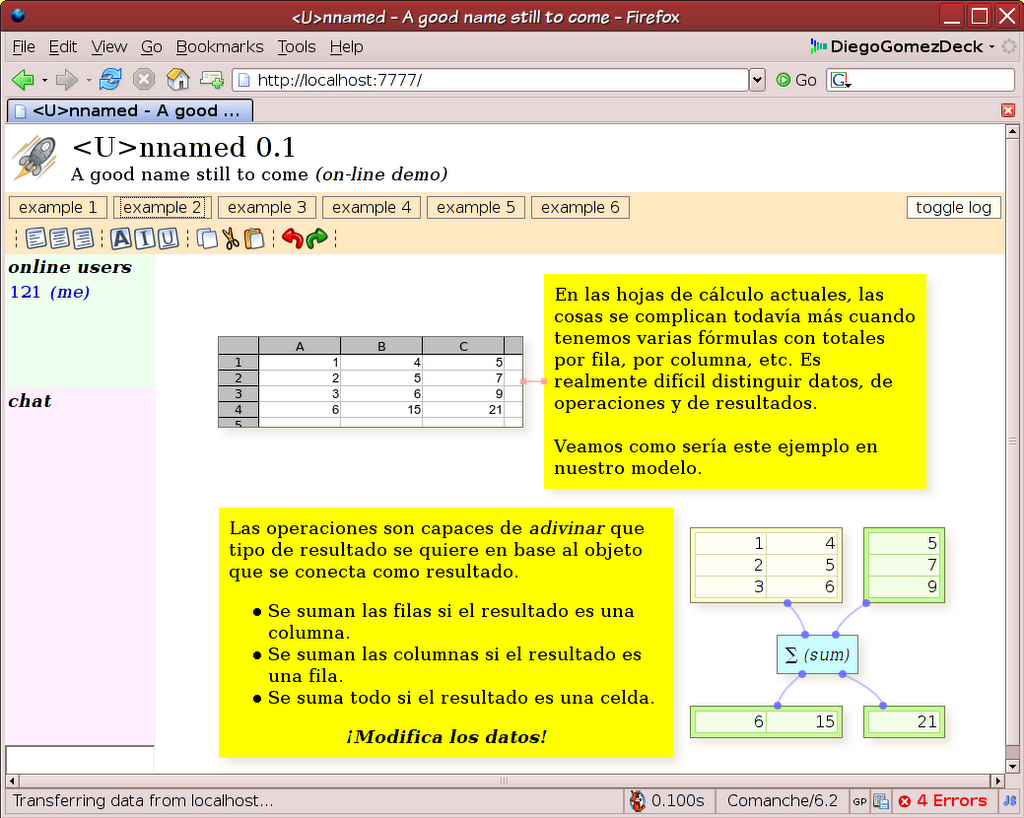
Since I have an Apple, and was playing at the Comet and stuff, I decided to make a spreadsheet sort of "serious" and collaborative copying the idea of \u200b\u200bconnecting boxes and adding up, collaboration allowing the Comet.
This is what I did:


And also, you can see in this screencast (another modern word more) where it is seen working.

http://www.consultar.com/trastero/U1-Reducido.htm


Procedure Of Church Registration

computer running Web 2.0


Via: http://croquetweak.blogspot.com/2006/09/squeak-for-every-child.html

We can see some pics of Squeak running on computers mythical 100USD.

Monday, September 11, 2006

Fastest Hunting Riffle

100USD - A new medium: Social Shopping

"Ahhhhhh" (with an open mouth that shows up the guts), that dream!

Another night Nahuel not let me sleep .... oops, now sleep! and I, I took 2 cups super-charged, I can not sleep a wink. Well, I'll write something on the blog to fight the dark loneliness of 5:30 am (and to try to break down too much caffeine in my body.)


's no secret that the last time I spent trying to find the limits imposed on us by modern Web browsers.

I can summarize what I learned at this time with the following sentence :

" browsers (Internet) today are a mess,

but can be used to better the current."


is now possible, not without considerable effort to take better advantage of the browsers. The turning point, I think, is the "massification" the new (well, nothing new) technology Comet ( http://es.wikipedia.org/wiki/Comet ). To be honest, "new" and "technology" are 2 words that do justice ... maybe we could say, "old" hack "and would be closer to describing what is Comet.

Either way (with hacks and all) can make web applications today where, finally, not all request / response ( http://es.wikipedia.org/wiki/Hypertext_Transfer_Protocol ).

Now, using the hack ^ H ^ H ^ H ^ H ^ H ^ H ^ Hla Comet technology, we creating collaborative applications. It is time (actually already has for years been an hour) to start looking for the real benefits of being all networked.

Today I want to show the evidence that I was doing: Social-Shopping .

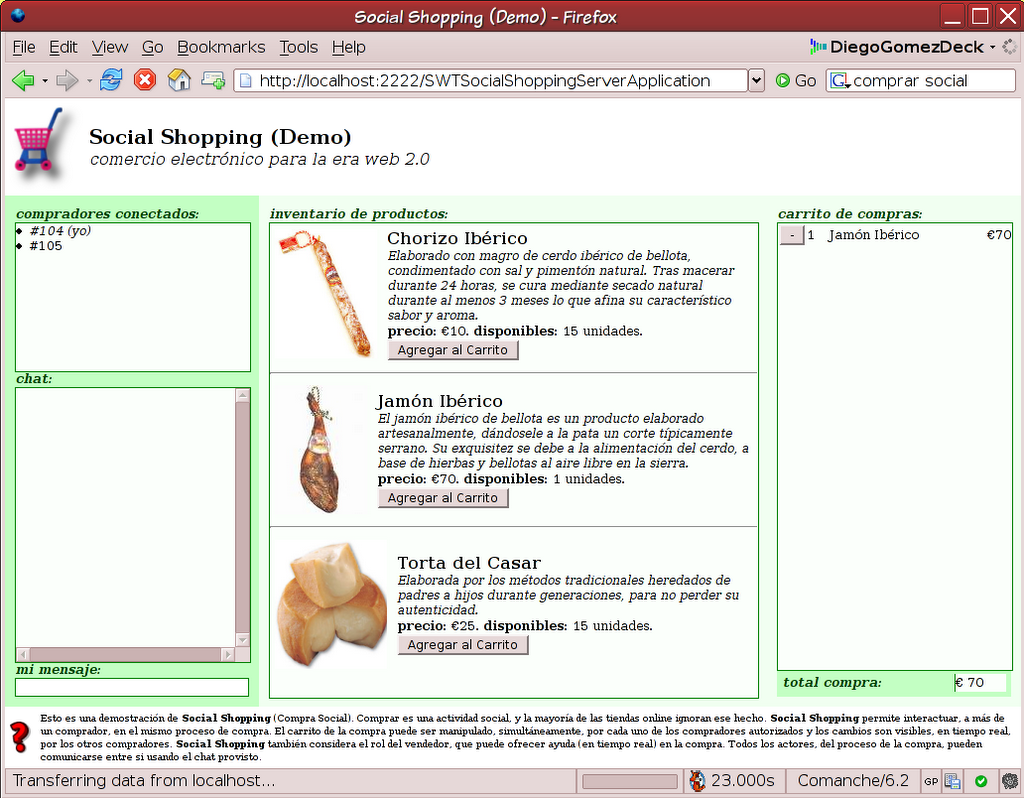
Social-Shopping is one of the examples included in the SWT. Basically, Social-Shopping is a simple collaborative cart. More than 1 person (can be more than 1 buyer, or buyers and sellers, or buyers and consultants, etc.) can interact through the Internet at a single checkout process.

Social-Shopping, for now, looks like this:


Yes, I know ... I speak of a "new media" and put a super-static PNG. Better, I leave a screencast where you see better idea:

http://www.consultar.com/trastero/SocialShopping1.htm


I have some more ejemplitos in the ink ... but do not want them displayed all together, to keep the attention high. ;-)

Bowel Movementscleaning

SWT (Squeak Web Toolkit) - Something else to show: Ping-Pong

Things are taking fomar and now its framework (SWT) allows us to make some funny examples. I'll show you one of the examples in SWT: Ping Pong.

Ping-Pong's example is, I believe, the most simple to use SWT, which in turn displays the interesting features of the framework.

Uhhh ... much introduction ... better go straight to the point.

use the framework to begin creating 2 classes: SWTPingPongClientApplication and SWTPingPongServerApplication .

The first ( SWTPingPongClientApplication ) is a subclass of SWTClientApplication . The second ( SWTPingPongServerApplication ) is a subclass of SWTServerApplication .

According to SWT, an "application" is split between his party and his party Client Server.
the client (in our example: SWTPingPongClientApplication ) is translated into JavaScript code (using the ST2JS) and runs in the Internet browser. In addition, the Server ( SWTPingPongServerApplication ) runs in Squeak.

for each browser (Internet) connected, have a couple of instances (the Server and Client) that remain "united" by the framework.

When we are on the client, can send messages to the Server in the following way:

self ServerSide foo.


Similarly, when we are in the Server can send messages to the Client as follows:
self clientside bar .

The Client part, to send the message # ServerSide , it returns a proxy that forwards messages to Squeak using JSON-RPC. In addition, the Server, when we send the message # clientside returns a proxy that forwards messages received, the client, using the Comet connection.

This we already know enough to see the sample code Ping-Pong.

the client side of our example ( SWTPingPongClientApplication ) has only 2 methods, see the first:

cr.
initializeWidgets
"Initialize the receiver's widgets"

contents: 'Ping Pong'
).
root addWidget: ( SWTButton caption:

'ping server' onClick: [ : event ] ). Allí vemos como se crean 2 widgets: Un Header y un Button. Si, lo sé... no es nada espectacular... pero lo interesante está dentro del evento #onClick del botón:

self serverSide ping Cuando hagamos click sobre el botón, el mensaje #ping se evaluará, ¡pero del lado del servidor!. Veamos entonces la implementación de #ping in the Server ( SWTPingPongServerApplication ). ping Transcript show: 'ping! " ;

self
clientside This method, and show something in the Transcript, returns the "favor" to his counterpart in the last line Client.
pong.
Now, finally, consider the implementation of Client side # pong (

SWTPingPongClientApplication ).

pong
^

self inform : "pong!"

If u like, watch this Screencast